
Tag: oracle
-
Exascale (3/3) – New ExaDB-XS OCI Service

This three-part series on Exascale highlights its role in enhancing Oracle’s Exadata services. The Exadata Database Service on Exascale Infrastructure (ExaDB-XS) offers virtual infrastructure, lower minimum resource commitments, and easier scaling compared to dedicated infrastructure. Exascale software is transformative, aiming to streamline storage and optimize resource management for varying workloads.
-
Exascale (2/3) – New Exascale Architecture
The article highlights advancements and limitations of Automatic Storage Management (ASM) in Exadata systems over 20 years. It discusses areas needing improvement, including resizing diskgroups, thin cloning, and redundancy. Oracle’s new Exascale software aims to address these issues, promising enhanced capabilities for storage management. Future articles will detail Exascale’s architecture and cloud services.
-
Exascale (1/3) – Why ASM Needed an Heir Worthy of the 21st Century
The article highlights advancements and limitations of Automatic Storage Management (ASM) in Exadata systems over 20 years. It discusses areas needing improvement, including resizing diskgroups, thin cloning, and redundancy. Oracle’s new Exascale software aims to address these issues, promising enhanced capabilities for storage management. Future articles will detail Exascale’s architecture and cloud services.
-
23c – Simplified PDB hot cloning in a Physical Dataguard environment

In one of the previous articles I superficially mentioned a relevant limitation in the combination of Multitenant + Dataguard in 19c: It simply cannot execute a synchronized hot cloning (primary cloning cascading to the standby). Today we are going to address that issue in detail, and we will discover an important improvement that we find…
-
23c – Floating PDBs – The Lab

The main objective of this laboratory is to understand the behavior of PDBs (Pluggable Databases) and services based on their configuration, particularly focusing on a “floating PDBs” configuration. We are interested in observing if the clusterware properly distributes the PDBs and their services during startup, verifying the behavior in case of a node failure in…
-
New Multitenant CPU management

Hello friends. Before starting this new article I want to thank you for the nice words and support you have shown for the blog. Today I bring you a topic that I particularly find really interesting. Maybe it is a bit long, but it is worth it. So make yourself a coffee and enjoy! Database…
-
19c – The mystery of Snapshot Carousel (Ch.2)
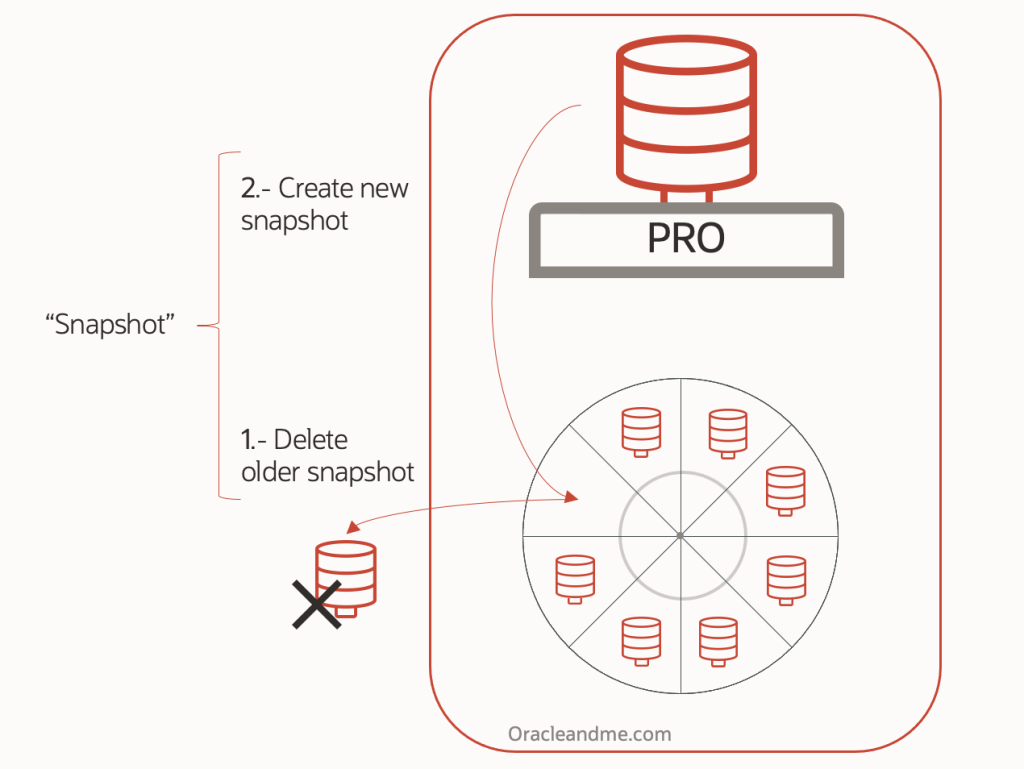
In the previous chapter we explained the reasons why the snapshot carousel feature still has significant limitations in Oracle 19c Release. While I particularly think the feature concept is certainly interesting, these limitations will probably prevent us from implementing such architecture. However, if we could know the SQL commands that snapshot carousel executes – since…
-
19c PDB “Snapshot copy” series- Chapter 3 – dNFS

In previous chapter 2nd we tested how easy is to implement PDB snapshot copies with a very simple setup. We leveraged this fantastic storage-based technology which is ACFS and it’s copy-on-write clones. In the example we used in that previous post, we had both the refreshable PDBs and the snapshot copies in the same CDB,…
-
19c PDB “Snapshot copy” series- Chapter 2 – ACFS

Today we will focus on a simple practical exercise where we are going to demonstrate how easy it is to create snapshot copies with a minimal infrastructure. We start from a 19c EE single instance database and ASM storage. This database consists of the CDB “CDBA” and the PDB “PDB1”, running on a virtual machine.…

